A legal notice is a letter, usually from an advocate, that sets out a claim against you and what the sender wants — payment, performance, an apology, that you stop doing something — and often a period within which they want it. It is not a court order. But how you respond in the next few days shapes everything that follows: a careless admission, a missed statutory period or a silence that looks like acceptance can all be expensive later.
This guide sets out a workflow that works for most notices a business receives in India — a commercial claim, a recovery demand, a cease-and-desist — and then shows how to run that workflow in Law Street. It is general information; for the notice on your desk, involve an advocate early.
Hour one: record the facts of the notice itself
Before anyone reads the claim closely, write down:
- the date on the notice, and the date you received it — keep the envelope, the courier slip or the email with its timestamp;
- how it was served: registered post, speed post, courier, hand delivery, email;
- who sent it (the party, and the advocate acting for them) and to whom it is addressed — the company, a director, an employee;
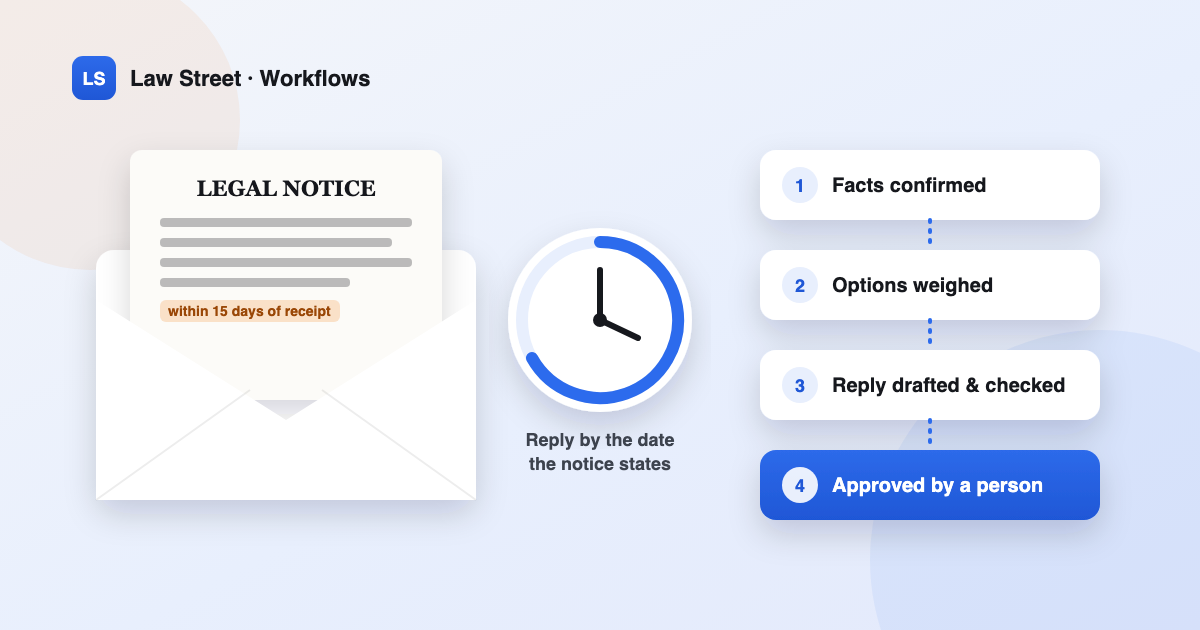
- any period it states ("within 15 days of receipt of this notice", "on or before 30 October").
The date of receipt matters because periods in notices — and in many statutes — usually run from receipt, not from the date printed on the letter.
Day one: work out what kind of notice it is
Most notices fall into a few families, and some carry statutory consequences on a clock of their own:
| If the notice is… | Why the clock matters |
|---|---|
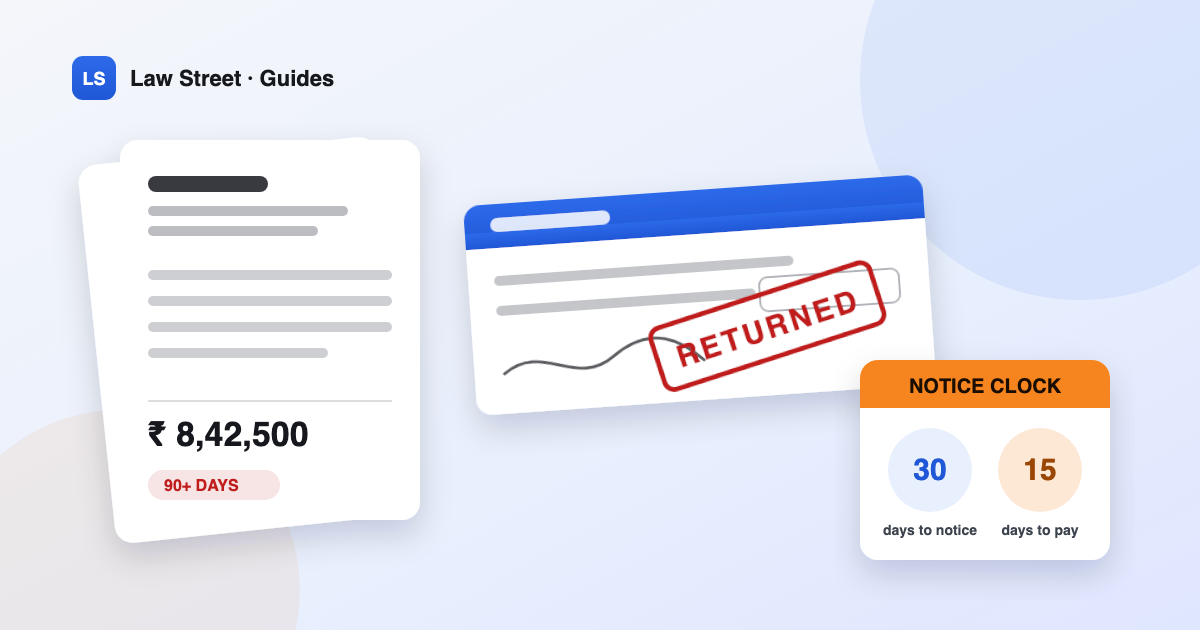
| A demand for a bounced cheque under section 138 of the Negotiable Instruments Act, 1881 | Paying the cheque amount within 15 days of receiving the notice prevents the offence from being complete. After that, the sender can file a criminal complaint. |
| An operational creditor's demand notice under section 8 of the Insolvency and Bankruptcy Code, 2016 | The company has 10 days from receipt to point out an existing dispute or pending proceedings, or to pay — before an insolvency application can follow. |
| A contractual claim (breach, termination, indemnity, unpaid fees) | Usually no statutory duty to reply, but the contract may have notice and dispute-resolution clauses with their own periods. |
| A cease-and-desist (trademark, copyright, confidentiality) | No statutory deadline as such, but a suit with an interim injunction application may follow quickly. |
| A tax, regulatory or government notice | These carry their own reply dates and procedures; treat them as a separate track with your CA or counsel. |
Not every notice creates a legal duty to reply. But an unanswered notice can be shown to a court later as part of the story — that you were told and said nothing — so a short, careful reply is usually better than silence.
Day one, continued: preserve evidence
Tell the people involved — sales, accounts, the project team — not to delete anything related to the dispute: emails, chats, drafts, invoices, delivery records. Collect the contract and every amendment, purchase orders, correspondence, and the ledger. Don't create new documents that argue the case internally; keep analysis with your advocate, where it can be privileged.
Days two to four: confirm the facts, one by one
A notice is the sender's version. Go through it allegation by allegation and sort each one:
- admitted — true, and you can't sensibly deny it;
- denied — untrue, and you can show why;
- not within your knowledge — you can't confirm or deny it yet;
- true but incomplete — the context changes its meaning.
For every fact you will rely on, note where it comes from: a signed contract, an email, a ledger entry, someone's memory. Facts from memory need checking before a reply rests on them.
Days three to six: decide what you want, then the strategy
Before drafting, decide the goal. Typical options:
- Comply — pay or perform, and close it.
- Negotiate — reply on the merits, and separately propose a settlement "without prejudice".
- Deny and reserve — a firm reply that denies the claim, sets out your position briefly and reserves all rights.
- Deny and counter-claim — where they owe you.
- Do nothing — rarely wise, and only as a deliberate choice with advice.
It helps to put rough numbers on the realistic options — cost, time, chance of each outcome — before you commit to one. Even a back-of-the-envelope comparison often shows that a quick settlement beats a strong but slow defence, or the opposite.
Drafting the reply
A good reply is short, accurate and careful:
- Refer to the notice by its date and the date you received it.
- Deny generally, then deal specifically with the allegations that matter. Don't leave a key allegation unanswered.
- State your position in a few paragraphs, with the documents you rely on.
- Admit nothing you don't have to. Don't speculate, don't apologise for things you don't accept, and don't reveal internal analysis or advice.
- Keep settlement offers separate, marked without prejudice.
- Reserve all rights.
Have it reviewed before it goes. A reply sent on an advocate's letterhead signals that you take the matter seriously, and an advocate will spot the admission you didn't notice you were making.
Sending, and after
Send the reply by a method that proves dispatch and delivery — the method the contract specifies, if it specifies one — and keep the proof with the matter. Diary the next dates: any period you gave, any period they gave, and the limitation period for your own claims if you have any.
The same workflow in Law Street
Law Street's Business and In-house legal workspaces have this workflow built in. Here is how it runs in the live demo (all data synthetic).
1. Log the notice. In Notices & disputes, choose "I received a notice" and paste the text or upload the PDF or Word file. Law Street extracts who sent it, what they claim and the dates — but the model is explicitly told not to compute any deadline.
2. Get the deadline from the notice's own words. The reply deadline is computed only from what the notice says — "within N days of receipt" or "on or before a date" — and counted in calendar days. If the notice states no period, the deadline is left as [●] for you to decide, and if it doesn't say where its period starts, Law Street counts from the date you received it and says so.
3. Confirm, and a matter opens. Nothing is saved until you confirm the details. Then Law Street opens a matter with a deadline task flagged for review, and the counsel's brief starts watching that date.
4. Confirm the facts. On the matter's Facts & evidence tab, each fact shows its source and whether a person has confirmed it. Critical facts that are still unconfirmed are listed as evidence gaps.
5. Weigh the options. Ask the counsel "We got a legal notice — what are our options?", or run the Outcome Lab to compare settling with contesting. The results are labelled as estimates, not predictions.
6. Draft the reply. Create a draft from the reply to a legal notice template. It is rendered from your confirmed facts; anything missing or unconfirmed is marked, and any AI-written paragraph waits as a suggestion until a person accepts it.
7. Check, review and approve. Validation checks run on the draft — required sections, consistent party names, dates, amounts in figures and words — and a draft can't be approved while a check fails. A colleague approves the exact version, bound to its hash.
8. Export and send. Export the approved reply as Word or PDF. Law Street never sends it: you or your advocate do.
Throughout, the matter's Flight Recorder shows every step: what was extracted, who confirmed which fact, which checks passed, who approved which version. If the dispute escalates, that record is the timeline your advocate will want.
A checklist for the first week
- Date of notice, date of receipt and mode of service recorded; envelope or email kept.
- The type of notice identified, and any statutory clock (15 days for a cheque notice, 10 days for an IBC demand notice) in the calendar.
- Relevant people told to preserve documents.
- Each allegation sorted: admitted, denied, not known, true but incomplete.
- Goal decided before drafting.
- Reply drafted from confirmed facts, reviewed by an advocate, and sent with proof of delivery.
Sources
- The Negotiable Instruments Act, 1881 — India Code (opens in a new tab) (section 138, proviso (c))
- The Insolvency and Bankruptcy Code, 2016 (section 8)
This guide is legal information, not legal advice. It reflects the law as the Law Street team understood it on 12 October 2026. Consult a qualified advocate about the notice you have received.