Every business that sells on credit eventually meets a customer who doesn't pay. Indian law gives a supplier several levers, and they are not interchangeable: each has its own conditions, its own clock and its own forum. Pulling the wrong one — or the right one too late — costs months.
This guide walks through the three statutory routes a business is most likely to use, in the order you would usually consider them:
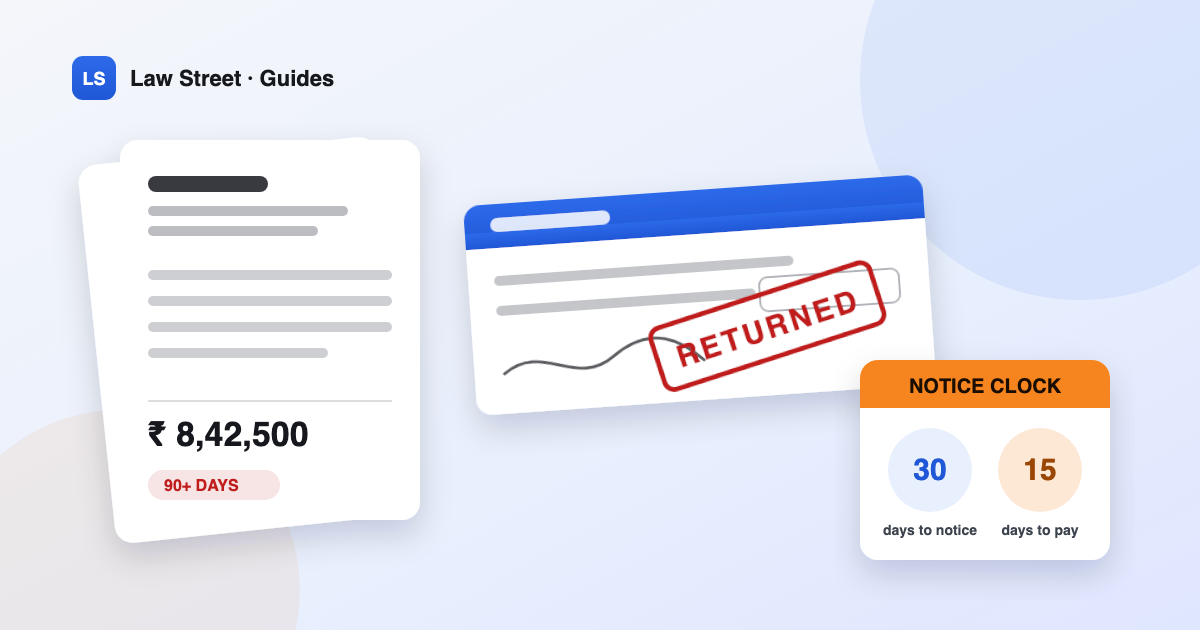
- A bounced cheque — the criminal complaint under section 138 of the Negotiable Instruments Act, 1881, with its strict 30-day and 15-day periods, and section 142 on where and when the complaint is filed.
- You are a micro or small enterprise — the delayed-payment provisions of the Micro, Small and Medium Enterprises Development Act, 2006 (sections 15 to 18): interest at three times the RBI bank rate and a reference to the MSE Facilitation Council, which you can make online through MSME Samadhaan.
- The civil route — pre-institution mediation, then a commercial or summary suit.
The primary sources are the Acts themselves, on the Government of India's official India Code portal: the Negotiable Instruments Act, 1881 (opens in a new tab) and the Micro, Small and Medium Enterprises Development Act, 2006 (opens in a new tab). Read the sections there before you act; this guide summarises them in plain language and cannot replace them, or advice from an advocate on your facts.
First, get the paper trail in order
Whatever route you choose, you will be asked to prove three things: that the customer owed you the money, how much, and since when. Before sending anything, gather:
- the purchase order, contract or written terms of credit, including any agreed payment period;
- invoices, delivery challans or proof of service, and anything showing the customer accepted the goods or services (a signed delivery note, an acceptance email, use of the service);
- your ledger for the customer and any balance confirmations or acknowledgements of debt they have signed;
- emails and messages about payment, including promises to pay and part-payments;
- for the MSMED route, your Udyam registration certificate, and its date;
- for a bounced cheque, the original cheque and the bank's return memo, with the date you received it.
Two dates matter more than any others: the date the customer accepted what you supplied, and — if a cheque bounced — the date you received the bank's information that it was returned unpaid.
Which route fits your situation?
| Your situation | Route to consider | The clock that matters | Primary source |
|---|---|---|---|
| A cheque given for the debt was returned unpaid | Demand notice, then a criminal complaint | Notice within 30 days of the bank's information; complaint within one month after the 15-day payment period ends | NI Act ss.138, 142 |
| You are a Udyam-registered micro or small supplier and the buyer paid late | MSMED Act interest; reference to the MSE Facilitation Council (MSME Samadhaan) | Payment due within the agreed period, never more than 45 days from acceptance | MSMED Act ss.15–18 |
| Any commercial dispute of ₹3 lakh or more without urgent interim relief | Pre-institution mediation, then a commercial suit | Limitation for the suit (generally three years) | Commercial Courts Act, 2015 s.12A |
| A written contract or negotiable instrument for a fixed sum | Summary suit | As above | Code of Civil Procedure, Order XXXVII |
These routes can run side by side. A supplier holding a bounced cheque may also be a micro enterprise entitled to statutory interest, and the criminal complaint does not stop a civil claim for the money.
Route 1: the cheque-bounce complaint under section 138
Section 138 makes it an offence when a cheque drawn on an account to pay a legally enforceable debt or other liability is returned unpaid because of insufficient funds, or because it exceeds the amount arranged with the bank. The punishment can extend to two years' imprisonment, or a fine of up to twice the cheque amount, or both.
The offence is only complete if three conditions in the proviso to section 138 are met, and each has a deadline:
- Presentation in time. The cheque must be presented within six months of its date or within its period of validity, whichever is earlier. Since 1 April 2012 the Reserve Bank of India has limited cheque validity to three months, so in practice the cheque must be presented within three months of its date.
- Notice within 30 days. You must send the drawer a written demand for payment within 30 days of receiving information from the bank that the cheque was returned unpaid — normally, the day you received the return memo.
- Fifteen days to pay. The drawer then has 15 days from receiving your notice to pay the cheque amount. If they don't, the offence is complete on the next day — that is the date the cause of action arises.
Section 142 then governs the complaint itself:
- The court takes cognizance only on a written complaint by the payee (or holder in due course), made within one month of the date the cause of action arises. A court may accept a later complaint if you show sufficient cause for the delay — but don't plan on it.
- The complaint is tried by a Metropolitan Magistrate or a Judicial Magistrate of the first class.
- Where to file: if you deposited the cheque for collection through your account, the court with jurisdiction is the one where your bank branch is located (section 142(2)).
Procedure in criminal courts is now governed by the Bharatiya Nagarik Suraksha Sanhita, 2023, which replaced the Code of Criminal Procedure on 1 July 2024. Section 142 still opens with "notwithstanding anything contained in the Code of Criminal Procedure", and its time limits are unchanged.
A worked timeline
Suppose a customer's cheque dated 1 June 2026 was presented on 10 June and returned for insufficient funds, and you received the return memo on 14 June 2026:
| Step | Rule | Date in this example |
|---|---|---|
| Information received from the bank | — | 14 June 2026 |
| Last day to send the demand notice | 30 days from receiving the information | 14 July 2026 |
| Notice delivered to the drawer | (example) | 18 July 2026 |
| Drawer's last day to pay | 15 days from receiving the notice | 2 August 2026 |
| Cause of action arises | Failure to pay within the 15 days | 3 August 2026 |
| Complaint to be filed | Within one month of the cause of action | Early September 2026 — file well before, not on the last day |
Two practical points follow from this table. The notice deadline runs from the day you received the bank's information, so record that date the moment the memo arrives. And the 15 days run from the day the drawer receives the notice, so send it in a way that gives you proof of dispatch and delivery — and keep that proof.
What the demand notice should do
The statute requires only a written demand for payment of the cheque amount. In practice an advocate's notice will also identify the cheque (number, date, amount, bank), the debt it was given for, the date and reason of return, and the 15-day period to pay. If you claim anything else — interest on the invoices, costs — keep the cheque amount clearly stated on its own, so that the demand for the cheque amount is unambiguous.
Section 139 presumes, unless the contrary is proved, that the holder received the cheque for the discharge of a debt or liability. That presumption helps the complainant, but it can be rebutted — which is why the paper trail above still matters.
Route 2: MSMED Act interest and the Facilitation Council
If your business is a micro or small enterprise registered on Udyam, Chapter V of the MSMED Act gives you rights that the buyer cannot contract out of. (Medium enterprises are not covered by these delayed-payment provisions: the Act defines a "supplier" as a micro or small enterprise.)
When payment is due — section 15. The buyer must pay on or before the date agreed in writing, and that agreed period cannot exceed 45 days from the day the buyer accepted (or is deemed to have accepted) the goods or services. If nothing was agreed in writing, payment is due before the "appointed day" — the day after 15 days from acceptance.
Interest — section 16. If the buyer pays late, it must pay compound interest with monthly rests at three times the bank rate notified by the Reserve Bank of India, from the appointed day or the day after the agreed date. Section 16 applies "notwithstanding anything contained in any agreement", so a clause waiving interest doesn't defeat it. Because the rate is tied to the RBI bank rate, always use the bank rate in force for the period — and check it on the RBI's website rather than assuming.
Recovery — sections 17 and 18. The buyer is liable for the amount with that interest. Either party may refer the dispute to the Micro and Small Enterprises Facilitation Council for the state. The Council first tries conciliation; if that fails, it arbitrates (or refers the dispute to an institution). The Act requires a reference to be decided within 90 days. A buyer who wants to challenge the resulting award must first deposit 75% of the amount awarded (section 19).
You can file a delayed-payment application online on the Ministry of MSME's MSME Samadhaan portal (opens in a new tab), which routes it to the relevant Council.
Working out the interest
Section 16 interest compounds monthly, so it grows faster than simple interest and is easy to get wrong in a spreadsheet. Law Street's calculator follows the statute: it finds the due date under section 15, then compounds at three times the bank rate you enter, month by month, and shows the working. It won't guess the bank rate — you enter the rate in force, and if you ask it to illustrate with a hypothetical rate, it labels the result as hypothetical.
Route 3: mediation, then a commercial or summary suit
For a commercial dispute of a specified value — currently ₹3 lakh or more — section 12A of the Commercial Courts Act, 2015 requires the claimant to try pre-institution mediation before filing a suit, unless the suit seeks urgent interim relief. Where a written contract or a negotiable instrument shows a fixed sum, Order XXXVII of the Code of Civil Procedure allows a summary suit, in which the defendant needs the court's leave to defend.
Keep an eye on limitation. Most claims for unpaid invoices must be filed within three years under the Limitation Act, 1963, counted from a starting point that depends on the claim and the credit terms. A written, signed acknowledgement of the debt (section 18) or a part-payment (section 19) made before the period expires starts a fresh period — another reason to keep every balance confirmation.
Insolvency proceedings against a company are a different tool: they are a collective process for the company's creditors, and the minimum default for starting one is ₹1 crore. They are not a substitute for recovering an ordinary trade debt.
Choosing between the routes
There is rarely one right answer. A few questions usually decide it:
- Is there a bounced cheque? Then the section 138 clock is already running, and it is the least forgiving one. Deal with it first.
- Are you a Udyam-registered micro or small enterprise? Then statutory interest is accruing whatever your contract says, and the Facilitation Council is often faster and cheaper than a suit.
- Is the customer solvent and the debt undisputed? A firm demand notice — or a summary suit — may be enough. If the debt is genuinely disputed, expect a contest and weigh the cost.
- What is the relationship worth? Settlement on a payment plan, secured by fresh post-dated cheques or an acknowledgement, can beat a judgment you struggle to enforce.
It helps to put rough numbers on each path — what it costs, how long it takes, how likely it is to work — before you choose. That is what Law Street's Outcome Lab is for: it lays out options such as "sue", "settle" and "refer to the Council" with ranges, runs thousands of simulated futures, and shows where each tends to end up. The results are labelled as uncalibrated estimates, not a prediction of any court's decision.
How Law Street helps with recovery
Law Street's Business workspace is built around exactly this problem:
- Money owed to you imports your receivables from Excel or CSV, groups them by debtor and age, and lists the recovery options that actually apply to each debtor — including MSME Samadhaan only where your Udyam status allows it, and a section 138 notice only where a cheque bounced.
- A cheque-dishonour matter asks for the facts the notice depends on — cheque number, date and amount, drawer and address, return reason and the return-memo date — and marks the critical ones until a person confirms them.
- The counsel's brief re-checks the 30-day notice window from the return-memo date every few minutes and warns you when that date is still unconfirmed or the window is closing.
- Drafting prepares a demand notice from confirmed facts, checks that the cheque was presented within its three-month validity, and won't let a draft be approved while checks fail. Nothing is ever sent to a debtor by Law Street: you or your advocate send the notice.
A checklist before you act
- Invoices, proof of delivery and proof of acceptance are together.
- You know the agreed payment period, and whether it exceeds 45 days.
- Your Udyam registration (if any) and its date are on file.
- For a bounced cheque: the return-memo date is recorded, and the 30-day notice deadline is in the calendar.
- The notice will be sent in a way that proves dispatch and delivery.
- Section 16 interest is computed with the RBI bank rate for the period, not a guessed figure.
- Limitation for a civil claim has been checked.
- An advocate has reviewed the notice and the route before anything is filed.
Sources
- The Negotiable Instruments Act, 1881 — India Code (opens in a new tab) (sections 138, 139 and 142)
- The Micro, Small and Medium Enterprises Development Act, 2006 — India Code (opens in a new tab) (sections 2, 15 to 19)
- MSME Samadhaan — Ministry of Micro, Small and Medium Enterprises (opens in a new tab)
- The Commercial Courts Act, 2015 (section 12A); the Code of Civil Procedure, 1908 (Order XXXVII); the Limitation Act, 1963 (sections 18 and 19)
This guide is legal information, not legal advice. It reflects the law as the Law Street team understood it on 12 October 2026. Check the current text of each provision and consult a qualified advocate before acting on your own facts.